Douglas Mcgregor Theory X Theory Y Pdf Free
DOUGLAS MCGREGOR’S THEORY X AND THEORY Y DOUGLAS MCGREGOR’S THEORY X AND THEORY Y. 10.2478/cris-2013-0012 Unauthenticated Download Date 7/5/17 11:35 PM.
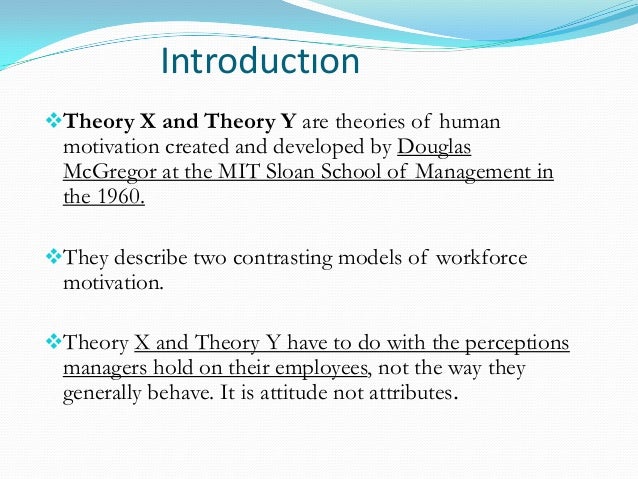
Motivation in the Workplace What motivates you to do a great job when you go to work? Do you care about the goals of the organization that you work for, or do you focus more on getting a regular paycheck to bring home? Douglas McGregor studied these questions and proposed two different views of employee motivation in his 1960 book 'The Human Side of Enterprise.' These views are known as Theory X and Theory Y. Definition and Assumptions of Theory X Theory X is based on a pessimistic view of employee motivation and behavior. Theory X assumes that employees dislike work, are not ambitious, want to avoid responsibility, dislike change, and are self-centered. Managers who hold these assumptions believe that employees can only be motivated by money, promotions, and job security.
Such managers are likely to use more of a command and control approach with their employees. Employees will cooperate if they feel their basic needs for income and security will be met. Definition and Assumptions of Theory Y Theory Y is based on an optimistic view of employee motivation and behavior. Theory Y assumes that employees enjoy work that is meaningful, are willing to take on responsibility, and are willing to work for organizational goals or causes they believe in.
Theory Y also assumes that employees are capable of creativity, ingenuity, and self-direction. Managers who hold these assumptions believe that employees are motivated not just by material needs, but also by higher-level needs, such as self-esteem and a sense of fulfillment. Since these are continuous needs throughout life, managers should address these needs when seeking to motivate employees. Giving employees more authority, broadening the scope of their jobs, and allowing them to have a say in decision-making can all motivate employees to work hard for the organization.
Validity of Theory X and Theory Y McGregor himself felt that Theory X had less validity than Theory Y. An employee whose physical or material needs have been met will still have higher-level needs that will not be fulfilled through Theory X management styles. Managers who hold Theory X assumptions will not offer sufficient incentives to motivate their employees to achieve organizational goals. Furthermore, if management becomes too coercive or punitive in trying to motivate employees, the result may be a resentful workforce and reduced worker output. Theory Y fits more closely with the assumptions made by most managers in today's business world. Roxio Creator 9 Activation. Giving employees a larger role in an organization makes it more likely that their individual needs will align with the organization's needs. Such employees will be more motivated to work for the good of the organization.
Theory Y therefore offers a more successful and more positive approach to employee motivation than Theory X. Lesson Summary Douglas McGregor's work builds on the work of other behavioral scientists who showed a link between human behavior, motivation, and productivity. McGregor's Theory X and Theory Y offer two contrasting models of employee motivation.
Theory X is based on a pessimistic view of employee motivation and behavior, while Theory Y is based on an optimistic view of employee motivation and behavior. Download Film Upin Dan Ipin Gong Xi Fa Cai more. Street Fighter 2 Mugen Characters Download there. Theory X managers believe employees are self-centered, dislike work, are unambitious, avoid responsibility, and dislike change. In contrast, Theory Y managers assume employees are self-directed, enjoy responsibility and meaningful work, and are willing to work for organizational goals or causes they believe in. According to McGregor, Theory Y offers a more successful and more positive approach to employee motivation than Theory X, since an employee whose physical or material needs have been met will still have higher-level needs that will not be fulfilled through Theory X management styles.